









FOSTER CARE GUIDELINES
Welcome…and thank you for participating in our Greyhound Foster Program.
Greyhound Pets of Arizona (GPA-AZ) is in constant need of individuals or families who are willing to open their homes and hearts to provide foster care for the retired racing Greyhounds. This care not only includes the general maintenance and safety of the foster dog, but we also ask that you assist us in providing basic training and socialization which is crucial for a successful adoption. We will provide you with support and guidance in every way we can, to make your fostering experience a rewarding one.
As a foster parent/family, you are a representative of Greyhound Pets of Arizona. Our focus is on Greyhounds as pets. It is a Greyhound Pets of Arizona policy to remain neutral, and not take a stand one way or another, on the Greyhound racing industry. Please remember this when you are introducing your foster dog to the public.
We hope you will read this manual with an eye toward continuing to improve our foster program or through sharing ideas and knowledge. Many of you will already know much of this material, but these guidelines are developed and reevaluated periodically to ensure that every aspect of fostering goes as smoothly as possible, both for you and your foster dog. Please feel free to make suggestions that you think may help other foster families.
Again, thank you for participating in our foster program. We hope that you will enjoy teaching your foster how to retire to a life as a loveable, loyal and well-behaved family pet.
Ownership of Foster Greyhounds
All foster Greyhounds are the sole property of Greyhound Pets of Arizona and shall be returned to Greyhound Pets of Arizona upon request, or if the foster parent/family is not able to adequately care for the Greyhound. Should you want to adopt the foster dog yourself, you must contact the foster coordinator. Until such time, the foster dog is considered available for adoption.
Foster Care Goals
An ex-racing Greyhound enters your life for a few weeks, usually for 4-8 weeks, although some dogs have been in foster care for longer or shorter periods of time (some never leave, the foster family ends up falling in love with and adopting the dog.)
As a foster parent/family, you are responsible for teaching the foster Greyhound as listed below:
- Housebreaking, if necessary
- Walking on a leash, if necessary
- Responding to his/her name assigned by Greyhound Pets of Arizona
- Appropriate behavior indoors and outdoors
- Proper interaction with other pets
- Proper play techniques with adults and children
The foster dog's personality will slowly develop and bloom. We will call you to get a profile of the dog's personality so that we can match him or her with the right adoptive family.
Remember: we are only a phone call away if you have any questions or need advice!
Your Foster Dog and Other Animals
Getting acquainted
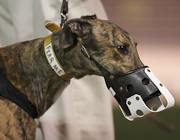
Take precautions while you are getting to know the dog's personality, especially when he/she is around other animals and children. Introduce them to one another slowly, always using a leash and muzzle. Never leave the foster dog alone with cats, small pets, or other dogs during this time.
Introducing the foster to your dogs
- Have the pets meet on neutral territory; for example, introduce them on the sidewalk in front of your house or down the block.
- Keep the foster dog on a short leash close to your side. Bring your dogs out on leashes one at a time.
- Keep the atmosphere calm and do not let your pets rush up to the new dog.
- Observe the reaction of the new dog and of your own dogs.
- Watch for signs of aggression and/or dominance:
1. Head and tail held high, stiff, and rigid
2. Maintaining eye contact
3. Hackles up - raised hairs along the spine from shoulder to tail
4. Ears pricked
5. Standing over - paws or head over other dog
6. Pushing or mounting
7. Grabbing muzzle of subordinate dog
8. Growling or snapping teeth
9. Any other signs you my feel are a threat to either animal - Once they have sniffed and greeted each other, take them around your property and into the house
- If all pets are behaving well with each other, you may remove the leashes, but leave the muzzle on and continue to monitor and supervise. Do not leave dogs unattended together until you are 100% confident that they are getting along well.
Introducing the foster dog to your cats
Introduce the Greyhound to your cat indoors with the Greyhound muzzled and leashed.
- Hold the leash tightly in your hand
- Leave the cat on the floor
- Walk toward the cat slowly
If the dog pulls or lunges, give a sharp pull on the leash and firmly say, "NO!" Correct the dog every time it shows interest in the cat. If used correctly, a spray bottle with water is helpful.
If you observe any of the following signs, please inform the foster coordinator:
- Teeth snapping
- Ears pricked
- Fixed gaze that cannot be broken
- Trembling or lurching
- Any other signs you may feel are a threat to either animal
Caring for the Greyhound
Foster parents/family must provide the following for the foster Greyhound:
- Good food
- Fresh water daily
- Love and affection
- Soft comfy dog beds (Greyhound Pets of Arizona prefers the dogs be taught to stay off human furniture. Dog beds can be simple as folded blankets or pillows on the floor.)
- Lots of guidance, supervision and training
The foster dog should be kept indoors as a house pet. Greyhounds have no undercoat or body fat to shield them from extreme temperatures. They have generally been kept indoors in temperature controlled kennels, and are accustomed to being around people. Being left outdoors may cause behavior problems, or worse, it could be fatal to the foster dog.
Training
Greyhounds are very responsive to no force, positive reinforcement methods of training. You should never hit a Greyhound. They are very sensitive to voice commands. Greyhounds respond better and learn more quickly though the use of positive reinforcement when they have done something right. They will repeat the action that worked for them. It may be frustrating at times and hard not to punish the dog for his/her wrong actions, but you are better off taking your frustration out on something else as the dog will not be able to associate your anger with the action and will simply learn not to trust you. Please don't hesitate to call for help in this regard! It is important for the hounds to learn appropriate manners and still be outgoing, happy dogs.
Medications
Unless prescribed by a Greyhound Pets of Arizona approved veterinarian, do not administer any over the counter or otherwise obtained medications to the foster Greyhound. Greyhounds have a low tolerance to many foreign substances and may have serious side effects. If you know of a natural remedy that you would like to use to help the foster dog in a situation, please contact the foster coordinator before administering the medication. Also know that certain pesticides are lethal to greyhounds. In the case that you need to use one for ticks or other outdoor pests, please use Diazinon and allow the area to dry completely before allowing the dogs to reenter.
Traveling
In order for Greyhound Pets of Arizona to place the foster dog in the best "forever home" the adoption counselor and foster coordinator need to have access to the dogs at all times. In the event that you are leaving town for any period of time, please contact the foster coordinator at least two weeks prior (or as early as possible) to work out a plan that will best suit you and the dog while you are away.
Insurance
We encourage you to enjoy your foster dog and socialize him or her as you would your own dog. We do, however, want to remind you that we do not carry insurance as a group. If your foster dog inflicts injury on another dog or person, your homeowner's insurance policy may cover you under the liability portion of your policy. You may want to check with your insurance company to find out how and when such protection is extended. Most importantly, be sure that everyone treats your foster dog with respect to prevent the situation from ever happening.
Swimming Pools
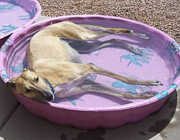
Most Greyhounds do not swim and because they have very little body fat, they do not float! You must take extra precautions in introducing the foster dog to your swimming pool. Do it gently and slowly. You just need to give them the understanding that it is not a solid walking surface. Once they realize that, they will more than likely stay away. However, that is not a reason to leave the dog unattended near the pool. The foster dog can easily walk too close to the pool and be bumped or just slip near the edge and fall in.
Dog Parks
Foster dogs are NOT to be taken to dog parks for the following reasons:
- Greyhounds have been bred to perfection for coursing. It is in the blood of these hounds and is total instinct to chase moving objects, whether it be a piece of litter blowing in the air or perhaps a small dog or cat. The difference between a Greyhound and most other dogs that chase what they see moving is that a Greyhound will actually catch the object. The Greyhound may not have any aggressive intentions, but with the excitement of all the other dogs joining in, you can never tell what would happen. This puts small dogs at risk of being injured.
- As you know, some Greyhounds may not be safe with smaller animals. Small and medium sized dogs may be at risk if you take the foster dog to a dog park.
- The foster Greyhounds could be injured by an aggressive dog visiting the park. Although the risk of injury to a foster dog is minimal, it is nevertheless, of concern to us. It would only take a couple of medical bills to put us in the red.
- Although rare, it is possible for the foster dog to contract a contagious disease through the feces of an already infected dog that may have been at the park previous to your arrival
Should you take the foster dog to a park or any place that Greyhound Pets of Arizona has not authorized for you to do so, Greyhound Pets of Arizona will expect you to be responsible for any legal, financial and medical problems that will occur.
Help With the Placement Process
The most rewarding part of fostering a dog is to see the end result. When you have nurtured the hound into becoming a very good house pet and see that it is ready for its "Forever Home," you also get to play a very important role in the placement and adoption process. In order to do this in an efficient manner you may be asked to be available for Meet-n-Greets, talk to prospective families, and drop off or pick up dogs from Greyhound Pets of Arizona events.
A Few Reminders Now That You Have a Greyhound in your House
- Check to be sure living area is secure and reinforce any loose fence material
- Contact any utility company that has free access to an area the foster dog may frequent in order to make arrangements and be able to prevent the hound from escaping your secure area. (i.e., pool caretaker, landscapers, meter readers)
- Please keep the foster dog separated from other pets when unsupervised